Reaction Bonded Silicon Carbide: Understanding Properties and Manufacturing Methods
Reaction bonded silicon carbide stands out as an advanced ceramic material with exceptional properties. It has a maximum use temperature of 1380°C and hardness second only to diamonds. This material is sintered at 1600°C under vacuum conditions and creates a unique structure with over 90% SiC purity and minimal porosity of less than 0.1%.
Material selection requires a significant understanding of sintered vs reaction bonded silicon carbide. RBSC offers a budget-friendly alternative to sintered silicon carbide (SSiC), though it exhibits lower strength and higher porosity. In this piece, we will take a closer look at the manufacturing process and key properties such as thermal conductivity and mechanical strength. We will also examine applications of this versatile ceramic material in a variety of industries.
Manufacturing Process of Reaction Bonded Silicon Carbide
The production of reaction bonded silicon carbide relies on a liquid silicon infiltration technique where molten silicon penetrates a porous preform. Manufacturers combine SiC powder with carbon sources and organic binders first, forming a mixture that can be shaped through pressing, injection molding, or extrusion. This preform undergoes carbonization in a vacuum furnace at temperatures around 900°C. The process removes the binder and maintains the part’s geometry.
Liquid silicon enters the porous structure through capillary action at temperatures exceeding 1410°C during the infiltration stage, silicon’s melting point. The molten silicon reacts with carbon according to the equation Si + C → SiC. This generates additional silicon carbide that bonds the original particles together. This exothermic reaction releases approximately 116 kJ/mol and can increase local temperatures by 400°C.
The final material consists of three distinct phases: primary SiC particles forming the structural framework, reaction-formed secondary β-SiC, and residual unreacted silicon filling remaining porosity. Silicon content ranges from 5 to 40 vol%. The exact proportion is controlled through preform design and carbon content.
This manufacturing route offers most important advantages over sintered silicon carbide. These include near-net-shape capability and dimensional changes below 1%. Processing temperatures remain low at 1450-1650°C, reducing production costs by 20-40% compared to traditional sintering methods.
Properties and Characteristics of RBSC
Material composition influences the performance characteristics of RBSiC directly, with residual silicon content playing a decisive role. The two-phase structure delivers a density of 3.0-3.17 g/cm³ and Young’s modulus ranging from 330-443 GPa based on silicon concentration. Lower silicon content produces elastic modulus values that approach sintered ceramics, with 6 vol% silicon achieving 443 GPa. Typical RBSC exhibits 350-400 GPa.
Mechanical strength varies based on microstructure refinement. Flexural strength spans 250-512 MPa, and ultrafine SiC systems reach 380 MPa through improved load transfer efficiency. Compressive strength peaks at 2393 MPa in optimized formulations, while Vickers hardness measures 2100-2500. Fracture toughness registers 4.0-4.72 MPa·m^1/2, sufficient for structural applications that are demanding.
Thermal properties benefit from the material’s low expansion coefficient of 4.3-4.5 × 10⁻⁶/°C and grant excellent thermal shock resistance. Thermal conductivity reaches 145-211 W/m·K at room temperature, though values decrease to 45-51 W/m·K at elevated temperatures. This high conductivity homogenizes temperature distributions faster and minimizes damaging gradients.
Chemical stability remains exceptional across harsh environments. The material tolerates strong acids and demonstrates good resistance to alkalis. Wear resistance and oxidation resistance extend service life in abrasive conditions.
Applications of Reaction Bonded Silicon Carbide
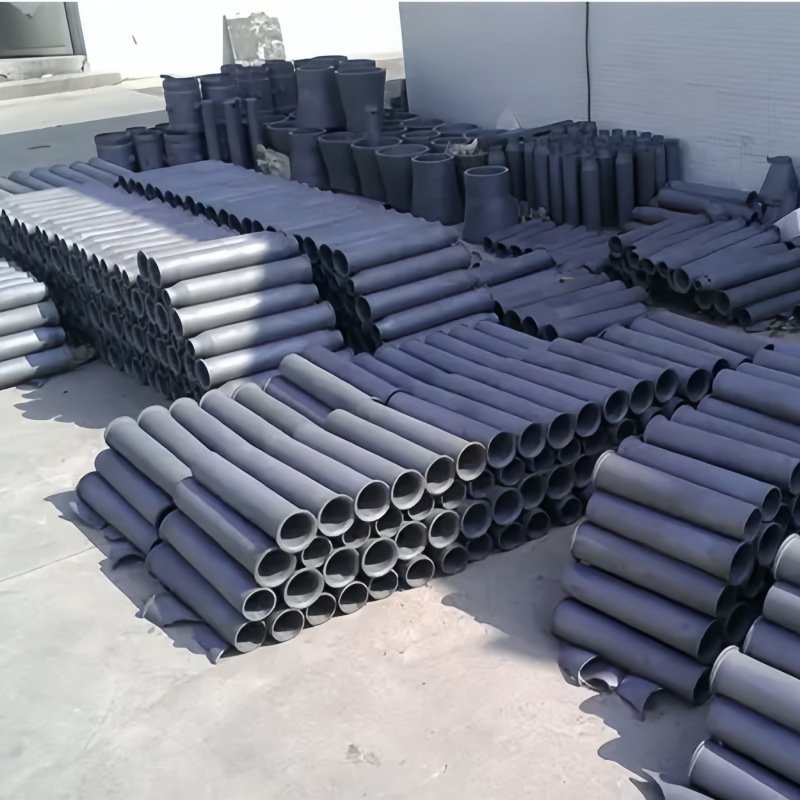
Industries that demand high-temperature performance and wear resistance have adopted reaction bonded silicon carbide in a variety of applications. Kiln furniture represents a main use case. Manufacturers produce low-mass supports, thin-walled beams, setters, heat exchanger, radiant tube, and burner nozzle. These components lower the thermal mass of kiln cars and result in energy savings and faster product throughput. RBSC kiln furniture costs about four times more than cordierite alternatives, though the performance benefits justify this premium.
Mechanical seal applications capitalize on the material’s exceptional wear resistance and chemical stability. SiSiC seal faces for mechanical seal operate in pumps that handle aggressive chemicals, slurries, and high-temperature liquids in chemical processing and oil and gas sectors. Careful control of free graphite levels determines seal performance characteristics. Graphite-containing grades serve as seal nose materials in hostile environments.
The negligible volume change during silicon infiltration makes precision component manufacturing possible. Laser mirror blanks, wafer handling devices, and optical benches benefit from the lightweight, stiff structure with excellent thermal stability. Other applications include wear components like screws and plates, blasting nozzle, plus thrust bearings that operate between -200°C and 400°C in contaminated liquids. Free silicon content restricts use in hydrofluoric acid and strong alkali conditions, but.
Konklusjon
Reaction bonded sic delivers strong performance through its infiltration manufacturing process. In fact, this method produces an affordable ceramic material with thermal stability and wear resistance. The final product contains 90% SiC purity with low porosity. This enables applications from kiln furniture to precision mechanical seals. Residual silicon content limits use in some chemical environments, but reaction bonded silicon carbide continues to serve as a solution for high-temperature industrial applications that require dimensional stability and durability.
 Norwegian
 English
 Swedish
 Danish
 Hungarian
 Dutch
 Finnish
 Arabic
 Bulgarian
 Czech
 German
 German (Austria)
 Greek
 Italian
 Spanish (Spain)
 French (France)
 Portuguese (Brazil)
 Romanian
 Slovenian
 Polish
 German (Switzerland)
 Spanish (Mexico)
 Spanish (Peru)
 Spanish (Chile)
 Estonian
 French (Belgium)
 Hebrew
 Indonesian
 Japanese
 Korean
 Lithuanian
 Latvian
 Dutch (Belgium)
 Portuguese (Portugal)
 Russian
 Slovak
 Thai
 Turkish
 Ukrainian
 Vietnamese